Lorevid
A short history of the English language
Learn about the origins of English, from its ancient roots to its modern form, and discover how different historical events shaped the language we use today.
The oldest ancestor of English
English belongs to a very old language family called Proto-Indo-European. This language was spoken by clans and tribes near the Black Sea a long, long time ago. Many languages around the world, like Latin, Russian, Persian, Sanskrit, and those spoken in India and Iceland, also come from Proto-Indo-European.
Some English words still sound like their ancient Proto-Indo-European forms. For example, the words mother, brother, sun, and star come from this old language. Linguists, who study languages, have found these old forms by looking at how words changed in later languages.
Sometimes, a word changes a lot over time. For example, the Proto-Indo-European root gembh-, which meant "tooth," became the English word comb.
From Proto-Indo-European to Proto-Germanic
Over time, the people who spoke Proto-Indo-European spread out. Some of them moved west into what is now northern Europe. As they moved, their language changed and became Proto-Germanic. This is another old ancestor of English.
In Proto-Germanic, some sounds changed. For instance, a "puh" sound often became a "fuh" sound. This is why the early form of father had a "p" sound, but now it has an "f" sound. Also, "kuh" sounds changed to "huh" sounds, like in the word head.
The early Germanic tribes also created new words or borrowed them from other groups. From them, we get words like blood, bone, ground, gate, soul, and sea.
Proto-Germanic then split into three groups:
- North Germanic: This group led to the Scandinavian languages.
- East Germanic: This group included the Gothic language, which is now extinct.
- West Germanic: This group is the ancestor of English.
Before English was born, the West Germanic tribes in areas like modern-day Denmark, the Netherlands, and Germany met the Romans. They borrowed some Latin words from the Romans, which tell us about Roman life. Examples include camp, wall, mile, street, cheese, and wine.
The birth of Old English
In the fifth century, Germanic tribes from Europe came to Britain. These tribes were the Jutes, the Angles, and the Saxons. They took control of much of the land, which became known as Angleland, or England.
The different West Germanic dialects these tribes spoke combined and developed into a new language: Old English. This was the first form of English.
Old English is very different from Modern English. If you read Old English, you would find it hard to understand. About 85% of Old English words are no longer used today. Its grammar was also very complex, with different word endings depending on the word's function in a sentence, and it had three grammatical genders: masculine, feminine, and neuter.
Old English also had dual pronouns, which were used when talking about exactly two people. Modern English only has singular (one person) and plural (more than one person) pronouns.
However, Old English gave us many basic words we still use every day. It also developed unique sounds like the "th" sounds in that and three, and the "juh" sound in edge and bridge.
Some of our irregular plurals in English also come from Old English. For example:
- feet (instead of "foots")
- mice (instead of "mouses")
- oxen (a rare example of an "n" plural from Old English)
Also, some words with an "f" sound in Old English sometimes changed to a "v" sound in the plural. This is why wolf becomes wolves.
Even our names for the days of the week come from Old English, honoring the Anglo-Saxons' gods:
- Tuesday (Tiu's day)
- Wednesday (Woden's day)
- Thursday (Thor's day)
- Friday (Frigg's day)
The influence of the Vikings
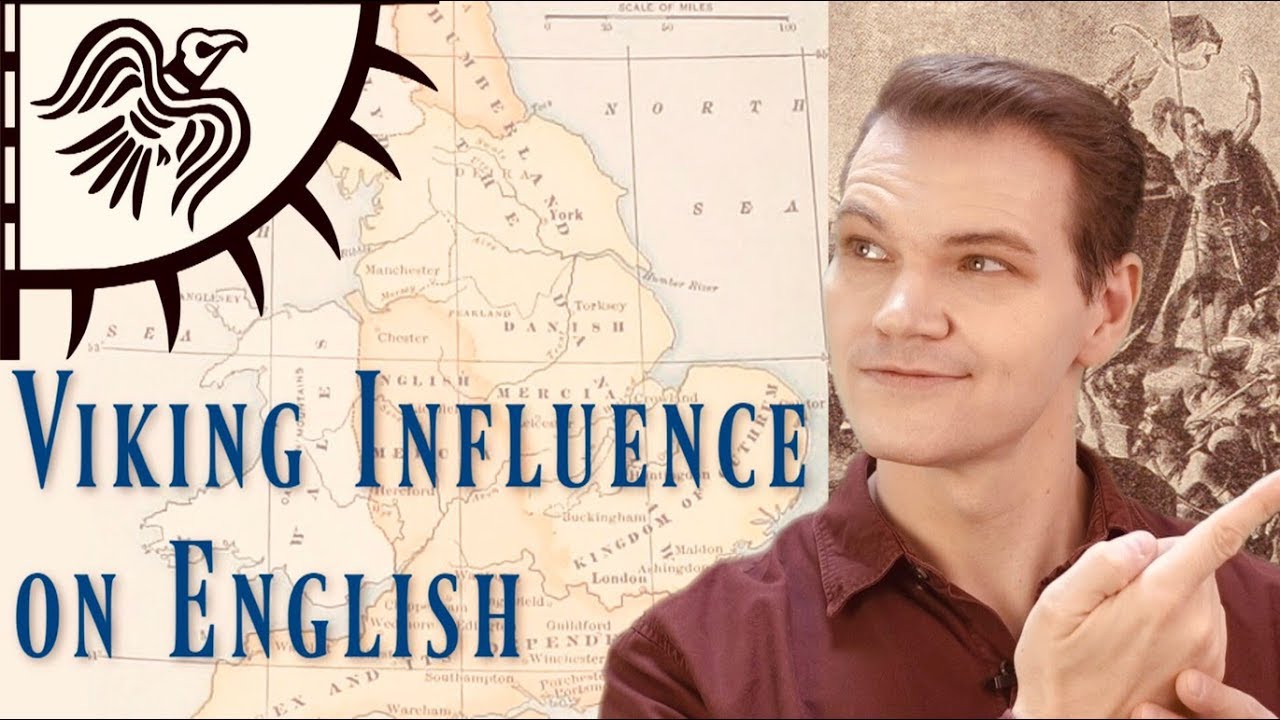
Later, the Vikings, who spoke Old Norse (a North Germanic language), arrived in England. They took control of a large part of the country, an area called the Danelaw. Old Norse and Old English were similar enough that people could understand each other.
The Vikings brought many new words into English. Some were words related to conflict, like ransack, slaughter, knife, and berserk. But they also brought common words used in daily life:
- take (verb)
- they, them, their (pronouns)
- are (verb)
It is possible that the influence of Old Norse helped to simplify English grammar by getting rid of grammatical gender.
The Norman Conquest and Middle English
In 1066, a group called the Normans, led by William the Conqueror, took over England. The Normans were Vikings who had settled in northern France and learned Norman French. After the conquest, Norman French became the language of the powerful people in England, like the nobility and church leaders.
To succeed in this new society, Anglo-Saxons had to learn French words. As a result, English absorbed a huge number of French words, especially related to:
- power
- justice
- art
- government
- law
- culture
The changes brought by French were so significant that the language changed its name. The period before the Norman Conquest is called Old English, and the period after is called Middle English.
For about 300 years, no English king or queen spoke English. But events like the Hundred Years' War with France and the Black Death helped English to become important again. In 1362, the English Parliament used English for the first time, and it soon became the official language in courts.
Middle English is easier to understand than Old English, but it can still be difficult. For example, the writings of Geoffrey Chaucer, a famous Middle English writer, are challenging to read in their original form.
During this time, grammatical gender disappeared completely from English. Also, some words lost their "h" sound at the beginning, perhaps because French speakers found it hard to pronounce. For example:
- hlaford became lord
- hring became ring
- hnutu became nut
The printing press and standardization
William Caxton set up the first printing presses in Britain in the 15th century. He printed the first books in English. This made books more widely available and helped to standardize the language.
Caxton printed books in his own dialect, London Chancery English. Because these books were read across the country, this specific way of writing English started to become the standard. The printers had a lot of power over how words were spelled, and their choices were often adopted throughout England.
However, some spellings were influenced by foreign printers from other parts of Europe. For example:
- gost (ghost) was spelled with an "h" like in Dutch.
- thum (thumb), crum (crumb), and lim (limb) were given silent "b"s, like in words such as comb, lamb, and womb.
- coud (could) was given an "l" to match should and would.
- Words that started with "hw" (like hwat for what) were changed to "wh" to match "th," "sh," and "ch" words.
The Great Vowel Shift and Early Modern English
Around the same time that spellings were being standardized, English pronunciation was going through a big change called the Great Vowel Shift. This happened over about 200 years, starting in the 15th century.
During this shift, the way English speakers pronounced long vowel sounds changed. For example, a word pronounced like "bought" at the beginning of the shift became closer to how we say boat today. "Maaat" became meat.
Because spelling was being standardized while these sounds were changing, some spellings represent older pronunciations that are no longer used. This is why English spelling can seem inconsistent today.
The Great Vowel Shift continued into the next period of English, which is called Early Modern English. This was the English spoken by William Shakespeare in the 16th and early 17th centuries. His writing is mostly understandable to us now, though some parts are a bit unusual.
During Early Modern English, the English translation of the Bible also became very important. The King James Version of the Bible, published in 1611, added many words to the English language, just as Shakespeare's works did. Shakespeare invented hundreds of words or was the first to write them down. Some examples include:
- dawn (from "dawning")
- successful (adding "ful" to "success")
- grovel (from "grovelling")
- hostile (from French)
- bandit (from Italian)
Early Modern English also saw English spread beyond Britain through colonialism, reaching America, India, and Australia. The transatlantic slave trade led to the creation of English creoles in Africa and the Caribbean, where people learned parts of English.
The Scientific Revolution also brought new words, often from Latin and Greek, like gravity, energy, experiment, and microscope. The need to understand these new words led to the creation of the first dictionaries. Samuel Johnson's dictionary, published in 1755, had 40,000 entries and set the standard for future dictionaries.
During this period, English speakers also started to drop some sounds from words. For example:
- The "k" and "g" at the start of words like knight and gnome stopped being pronounced.
- The "t" in words like castle and hasten was no longer sounded.
- The "l" in words like folk and palm disappeared for many speakers.
Additionally, the verb do began to be used in new ways:
- In questions: "Do you not love me?"
- To create negatives: "I do not enjoy Shakespeare."
- For emphasis: "I do think you should click subscribe now."
Modern English
The Modern English period began in the 1800s and continues today. Technology has greatly influenced the development of English during this time, from the penny post and the telegraph to the telephone, radio, and television.
English has also borrowed many words through colonialism, trade, culture, and two world wars.
Some characteristics of Modern English include:
- More passive voice: We often use sentences where we do not say who performs the action. For example: "My cat is being neutered today." (We don't know who is neutering the cat.)
- Phrasal verbs: These are verbs combined with a preposition or adverb, and they can have many different meanings. For example, come up with, come across, come down, and come out all mean different things.
English is still changing. The internet has helped new ways of speaking, like "because reasons," to spread quickly. With around 1.5 billion speakers, English is a very strong global language.
This article is based on the video
 The entire history of English in 22 minutes
RobWords