Lorevid
How the Vikings Influenced English
This article explains how the Old Norse language, spoken by the Vikings, changed English. You will learn about the words and grammar that came into English because of this contact.
English is a West Germanic language, like Dutch and German. Modern English comes from Old English, which was spoken by Germanic tribes who moved to Great Britain in the fifth century. However, English also has many influences from other languages. One important influence came from Old Norse, the language of the Vikings.
Historical Contact
Viking invasions and settlements in England took place during the 8th, 9th, and 10th centuries. A large part of England, known as the Danelaw, was under Danish Viking control from 878 to 954. Both English people and Scandinavians lived in this area. They interacted a lot and often married each other. This close contact meant that their languages, Old English and Old Norse, also came into contact.
Old English and Old Norse were related languages. They both came from Germanic languages. Before the Viking invasions, the languages were likely similar enough for people to understand each other, at least partly. They also shared many words that were cognates. Cognates are words that come from the same origin and often look and mean similar things in different languages.
Vocabulary Changes
When Old English and Old Norse speakers lived together, English vocabulary changed. A study of Germanic words in English shows that about 50% of these words have cognates in both Old English and Old Norse. About 14% of Germanic words in English come only from Old Norse. This may seem like a small number, but many of these words are very common and basic.
Languages usually borrow words for new ideas or more complex things. Borrowing basic, everyday words shows a long and close period of contact between two languages.
Here are some examples of basic words that came into English from Old Norse:
- Pronouns: The third-person plural pronouns they, them, and their come from Old Norse.
- Animals:
- reindeer from Old Norse hreinn dýr
- gosling (a young goose) from Old Norse gæslingr
- egg from Old Norse egg
- wing from Old Norse vængr
- Nature and Landscape:
- bark (of a tree) from Old Norse bǫrkr
- root from Old Norse rót
- sky from Old Norse ský (originally meaning 'cloud')
- Negative Words:
- anger from Old Norse angr
- die from Old Norse deyja
- ill from Old Norse illr
- rotten from Old Norse rotinn
- ugly from Old Norse uggligr
- Body Parts:
- leg from Old Norse leggr
- skin from Old Norse skinn
- Common Objects:
- bag from Old Norse baggi
- ball from Old Norse bǫllr
- knife from Old Norse knífr
- Verbs:
- The plural present tense of the verb 'to be', are, comes from Old Norse eru.
- call from Old Norse kalla
- hit from Old Norse hitta
- take from Old Norse taka
About 1,000 Old Norse words became part of standard English. This number is even higher if we include words in northern dialects of English, like the Yorkshire dialect.
Grammar Changes
English changed a lot from Old English to Middle English, becoming simpler in its grammar. This change may have been influenced by Old Norse.
Old English was a synthetic language. This means it used many inflections (changes to the end of a word) to show a word's role in a sentence. For example, nouns had different forms for different cases like nominative, genitive, dative, and accusative. Adjectives and articles also had different forms based on gender and number.
For example, in Old English, the phrase "the heavy stone" could be:
- se hefiga stan (subject)
- þæs hefigan stanes (possessive)
- þæm hefigan stane (indirect object)
- þone hefigan stan (direct object)
In Middle English, most of these different forms were lost. For a single "heavy stone," there was usually only one main form. For the possessive, there was "the heavy stanes." In the plural, the ending -s became common for most nouns, simplifying the grammar greatly.
English became an analytic language. This means it relies more on word order and prepositions (words like 'in', 'on', 'at') instead of inflections. For instance, in Old English, you could move parts of a sentence around, and the inflections would still show which word was the subject. In Middle English, with fewer inflections, the position of words became more important to understand the sentence. The subject usually came first, followed by the verb and then the object.
Verb forms also became simpler. Old English had strong verbs (which changed a vowel in the middle to form the past tense, like 'sing' -> 'sang') and weak verbs (which added a suffix, like 'walk' -> 'walked'). Many strong verbs disappeared, and new verbs often adopted the weak past tense forms. This made verbs more regular.
Another change was the use of auxiliary verbs. These are helping verbs used with other verbs to show tense or mood. In Old English, there was no special future tense; the present tense was used for future actions. In Middle English, words like shall and will began to be used to show the future, for example: he shall look (he will look) or he will shield us (he will protect us). This was another sign that English was becoming a more analytic language.
Theories of Influence
Historians and linguists have different ideas about how Old Norse influenced these changes in English.
One common idea is that Middle English developed directly from Old English. In this view, as Scandinavians learned English, they made small changes to the language because of their own language habits. Or, English speakers borrowed words from Old Norse. This view suggests that Old Norse was an underlying influence, but it did not change the core of the English language.
Another idea is that Middle English was a Creole. A Creole is a new language that forms when people who speak different languages come into close contact and need a way to communicate. Typically, the vocabulary comes from the language with more power, and the grammar is much simpler than either of the original languages. If English were a Creole, it would not be classified as purely West Germanic or North Germanic.
However, this theory has a problem: true Creoles usually have even simpler grammar than Middle English did. For example, they often do not have different verb forms for person or tense, or gender and case in pronouns. Middle English kept some of these features. Perhaps because Old English and Old Norse were already so similar, speakers did not need to create an entirely new language. Instead, they might have simplified their speech, using fewer complex grammar rules, to communicate more easily.
A newer theory suggests that English is actually a North Germanic language, not a West Germanic one. This idea says that the English people learned Old Norse, rather than the Scandinavians learning Old English. According to this theory, Middle English is based on Old Norse with many Old English influences. This theory points to similarities in sentence structure between English and North Germanic languages (like Norwegian, Swedish, and Danish) that are not found in Old English or other West Germanic languages.
For example:
- Verb-object order: In English, the verb comes before the object (e.g., "I can play the piano"). This is like North Germanic languages. In West Germanic languages like Dutch and German, the main verb often comes at the end after the object (e.g., "I can the piano play"). Old English was similar to Dutch and German in this way.
- Preposition stranding: This means a preposition can appear at the end of a sentence or clause without a noun following it (e.g., "That issue was talked about"). This is common in English and North Germanic languages but rare in many other languages.
- Split infinitives: This happens when a word (often an adverb) is placed between "to" and the main verb in an infinitive phrase (e.g., "I promise to not do that again"). This structure is common in English and modern North Germanic languages, but it did not occur in Old English or in Dutch or German.
When languages borrow from each other, they usually borrow words, not grammar structures. However, when there is very close and long-term contact, and when many people speak both languages, structures can be borrowed. Since Old Norse was spoken by many people living side-by-side with Old English speakers, it is possible that English borrowed grammar structures from Old Norse.
The most common view is that the traditional idea still holds, that English is primarily West Germanic. However, there may have been some language mixing, especially in the northern areas of England where Viking influence was strongest. When Middle English became standardized, the East Midlands dialect was chosen as the basis. This dialect was in the middle of the more Scandinavian-influenced northern dialects and the more Anglo southern dialects. This choice limited the amount of Norse influence on standard modern English, making it more West Germanic than North Germanic overall.
This article is based on the video
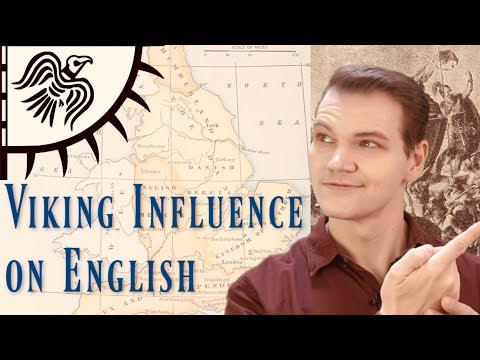 VIKING INFLUENCE on the English Language!
Langfocus